
After Maduro
Trump abducted the Venezuelan dictator in a shock-and-awe operation, freeing the country of Chavistas for the first time in decades. What could go wrong?

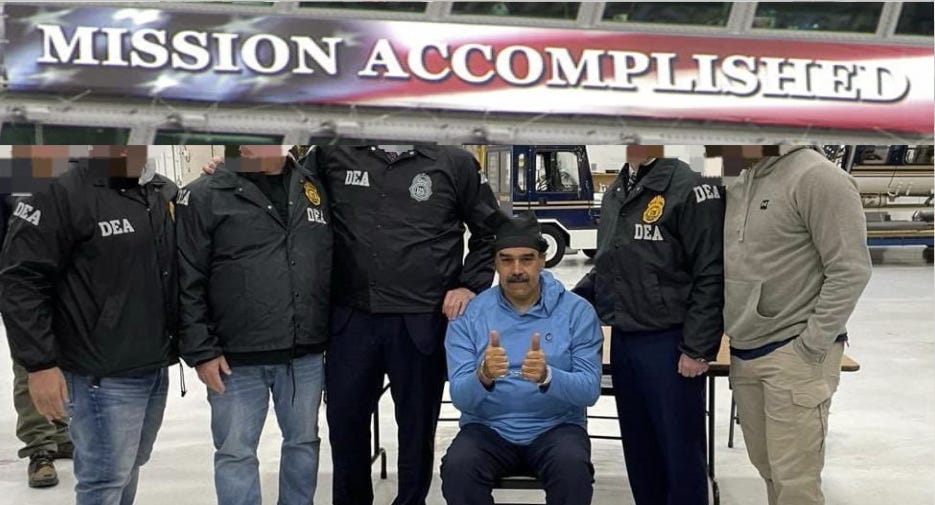
It was a pretty open secret among people interested in foreign policy that the Trump administration was going to attack Venezuela with the goal of overthrowing dictator Nicholas Maduro. For months now, American naval carriers have been stationed in the Caribbean and diplomats have taken a much louder and harsher policy towards the country. The only question was when Trump would attack.
We found out last night. In a Panama-style operation, American Delta Force troops descended upon Caracas, launching airstrikes on La Guaira port and major Venezuelan military bases at Fort Tiuna and Magdalena Island. The attack caught the Venezuelan government by surprise - Maduro had expressed readiness to negotiate with Trump just a day prior.
What is known about the operations is that the American government had extensive knowledge of Maduro and his regime prior to the attacks, with CIA assets active in the country since August. When the bombs hit and Maduro fled to his safe house, Delta Force teams were able to intercept him and capture him and his wife. Neither the recently-increased number of Cuban bodyguards nor the years of military purges and coup-proofing could save him.
Maduro is now in U.S. custody in New York. American officials are relieved at the success of this operation, and Venezuelans are jubilant that Maduro is gone. So what next?
Venezuela’s Political Future
Unlike prior regime-change operations in Iraq and Panama, the United States seemingly only went for Maduro instead of cleansing the top brass. The home of Minister of Defense Vladimir Padrino Lopez was bombed, and the fog of war led many speculators to assume that Lopez was killed. Otherwise, officials such as Vice President Delcy Rodriguez and Minister of the Interior Diosdado Caballo were both reported to be alive (as was Lopez).
These three; Lopez, Rodriguez, and Caballo are known for being very staunch loyalists to Maduro. Caballo and Lopez were both listed as wanted under the State Department’s Narcotics Rewards Program in January 20251, with Maduro not being listed until August.
After the strikes, Lopez released a video from a bunker calling the strikes illegal and that there would be resistance. Rodriguez called on the U.S. to return Maduro on the afternoon of Jan. 3; later that night, she assumed the presidency in Maduro’s place. As it stands now, the Venezuelan government has largely filled in Maduro’s spot and replaced only the figurehead of the regime.
Maria Corina Machado, the winner of the 2025 election who the U.S. government painstakingly helped free from Caracas, was snuffed from leadership in a statement by Trump, who said she “didn’t have the respect within the country [to lead].” Both Machado and her running mate, Edmundo Gonzalez, supported the overthrow of Maduro but did not comment on Trump’s execution of it.
When the United States invaded Panama to overthrow Manuel Noriega, who remained in power despite losing an election, American forces swore in the winner Guillermo Endara within hours of entering Panama City. They had told Endara that if he did not accept the presidency, the country would be subject to an American occupation. This is a direct contrast from Trump, who did not grant Machado or Gonzalez2 the same choice Endara had and instead said that the United States would “run” Venezuela indefinitely. Trump, however, said American troops would not be deployed if Rodriguez “does what we want.”
In this context, it can be entirely assumed that the United States overthrew an anti-American dictatorship with a pro-American one, without the precepts of democracy openly on the table like in previous post-Cold War regime changes. The possibility of Rodriguez being an interim president until actual elections can be held has been thrown around, but whether those elections - if they happen - would be free and fair is another question, especially given Trump’s threat of American troops if Rodriguez doesn’t abide by American demands, which may include rigging an election later on.
Within the government, the possibility of a Chavista loyalist counter-coup in the short term cannot be dismissed. Maduro packed his military and government with loyalists to prevent a coup from within, and built a relatively-strong intelligence network alongside it. If there exists an opportunity for a regime official or very gung-ho Chavista officer to exploit tensions and seize power, they very well might.
Shifting Views
When brutal dictators are overthrown, people are happy because freedom from that dictator’s oppression gives them hope for a better future, economically and politically. If the post-dictator regime is too weak and ineffective or another dictatorship takes hold, people will get nostalgic for the previous government.
In Iraq in 2003 and Afghanistan in the 2000s, Baathist and Taliban (respectively) insurgencies grew as a result of people believing that the new government were American puppets and ineffective, and these groups having something tangible or intangible to offer to dissuaded civilians.
If the lives of average Venezuelans do not improve, they will turn against the pro-American government de facto installed by Trump. One mysterious group, dubbed the Garapayla Revolutionary Movement, announced it’s existence in December 2025 and said that they would fight against foreign military intervention in Venezuela. The Colombian paramilitary ELN, who tightly controls eastern Colombia, has also expressed support with their ally the Maduro regime.
Additionally, the Tren del Llano and Tren de Aragua cartels have been opposed to the Maduro regime, although they are not fans of Machado and democratic opposition. These groups have waged a war against the Venezuelan government for years. As the American attacks were ongoing, Tren del Llano released a statement urging it’s members to attack the government. The post-Maduro government will find a continued enemy or new shaky ally depending on if Tren del Llano and co. benefit from the new government.
Another possible thorn in the side of the new government will be the colectivos, or groups of thugs loyal to Maduro that suppressed opposition during elections. If elements of the Maduro regime that the colectivos were loyal to remain in power, the risk of a larger colectivo anti-government conflict is much lower. However, the point still stands: Maduro created a network of armed gangs loyal to him. Now that he’s gone, will they keep that loyalty?
It will take time for any new cracks in the post-Maduro government to happen. After the fall of Assad in 2024, the Assadist insurgency took weeks to months to form, and widespread sectarian violence didn’t emerge for several months. Even then, major opposition insurgent figures and backers- Rami Makhlouf, Ghazal Ghazal, and Hikmat al-Hijri manipulated and abused government weakness to gain power. While Venezuela doesn’t have as diverse an ethno-religious makeup nor history of war like Syria, the seeds for a similar insurgency (or insurgencies) are very well present.
Donroe in Theory
From a Trumpist perspective, the United States liberated Venezuela from a communist dictatorship, bringing peace and reviving capitalism. Any problems resulting from this are Venezuelan problems, not American ones. As long as the new Venezuelan government follows Trump’s demands (and with it American foreign policy), there should be no issues between Venezuela and America.
The success of the operation to remove Maduro is surely making the American government conceive of future regime-change operations against countries they disagree with. In fact, they’re floating ideas openly right now, under the self-titled Donroe Doctrine. On January 3 alone, Trump or a Trump administration official has threatened or floated the idea of regime change with Cuba, Greenland, Colombia, and Mexico. Let’s go through these.
The Cuban dictatorship is a point of contention for Secretary of State Marco Rubio, whose family fled from Cuba. There is a very large and very influential Cuban-American diaspora in the Americas, who are a bulwark of Trump’s Latino base and contribute heavily to lobbying the U.S. government to maintain sanctions and other anti-government measures against Cuba. In regards to the overthrow of Maduro and the American intelligence networks that permitted it, Rubio said “If I lived in Havana and I was in the government, I’d be concerned a little bit.”
The Cuban regime was also a major ally of Maduro. Rubio said that the “whole [Venezuelan] spy agency was full of Cubans … this poor island took over Venezuela.” During the buildup to his overthrow, Maduro increased his security detail with Cuban mercenaries. This clearly didn’t help, as Trump said “You know, many Cubans lost their lives last night.” Cuban president Miguel Diaz-Canal went as far as to say “we are prepared to give blood for Venezuela” after the overthrow.
If there is a country that I would say is “next” in terms of regime change operations by the United States, I would personally bet on Cuba. The weak, flailing government has dealt with protests in recent years, and after the success of the Venezuela overthrow, the Trump administration is more inclined to listen to the large Cuban-American lobby and Cuban-American Secretary of State in overthrowing a communist country in America’s geographical backyard. However, Cuba doesn’t have massive oil resources like Venezuela did, hampering any economic or resource justification to invade; Venezuela’s resources were a topic Trump touched on heavily at his Jan. 3 press briefing.
Cuba, Colombia, and Mexico were all on Trump’s list of countries he threatened next. Trump called Colombian president Gustavo Petro, who has been one of the loudest critics of Trump in the western hemisphere, a cocaine dealer who “needs to watch his ass.” During and after the attacks on Venezuela, Petro posted news of everything on Twitter. On the night of January 3, he posted several gruesome photos of Venezuelan military corpses (one was not from the attacks). He also accused Mexican president Claudia Sheinbaum of being a puppet of the cartels, and that “something’s going to have to be done with Mexico”.
Colombia and Mexico are much larger countries than Venezuela with a population largely in support of their leaders. Sheinbaum was elected in a landslide in 2024, the same year as Trump, and maintains a good bit of popularity. Petro is less popular than Sheinbaum, but is still the democratically-elected president of a country in the shadow of a long-standing conflict. Any regime change operation here will be much more catastrophic for the region and for the United States than Venezuela.
Katie Miller, wife of White House Director of Policy Stephen Miller (who has been likened to “shadow president”), posted a photo of Greenland under the American flag with the caption “SOON“. Trump has made calls to buy or invade Greenland earlier in 2025, part of a new American irredentist ambition. Greenland is an autonomous territory of Denmark, a key EU and NATO ally friendly to the United States. The brazen irredentism by Miller indicates that some officials of the White House support regime change and interventionism with the goal of American control of an area instead of influence.
With Trump’s statement of “we will run Venezuela”, it is clear that Trump administration-led regime change includes the implementation of American-friendly puppet states like in the Cold War and early 1900s. If Miller’s style of irredentism becomes White House policy, a Cuban regime change operation may awaken pro-government voices calling for Cuba to become an American state or territory like in 1898. The Trump administration is now much more comfortable in conducting another regime-change operation if they please given the success of capturing Maduro, the only question is who, when, and where.
Spheres of Influence
In 2019, American officials became aware of the push by Russia (spearheaded by Vladimir Zhirinovsky) to “give” the United States Venezuela in exchange for Russian control of Ukraine. At the time, the U.S. scoffed and said no. But the warming of American and Russian relations under Trump and the de facto acceptance of “spheres of influence” in the 2025 National Strategy by his admin suggest that now that Trump has control of Venezuela, he will give Russia a carte blanche in Ukraine.
The difference is, Russia is bogged down in Ukraine and has been for years. Thousands of VDV soldiers tasked with capturing the Hostomel airport and assassinating Zelenskyy were killed; no American servicemen died in Caracas. Russia has tried (and failed) many times to capture or kill Zelenskyy and Ukraine’s top brass. Less than 24 hours after the first bomb hit Venezuela, Nicholas Maduro is at a DEA detention site in New York. China, however, has not invaded Taiwan yet, and if the spheres of influence theory applies to Taiwan, there will be no U.S. military intervention.
If the Western hemisphere is America’s sphere of influence under the Donroe doctrine, where we can oust and install governments friendly to us at will, then we will be in for a wave of anti-American sentiment across Latin America and the Caribbean. One wrong move could spark a civil war in tenuous countries like Mexico and Colombia, taking the lives of thousands of people. No matter how American officials justify the initial regime-change, the consequences of a regime change will shape American policy for decades.
Hitler’s idea of Lebensraum was built on the most maximalist, cherry-picked interpretations of German historical territory. If America seeks to conquer and rule over territories, including those like Greenland that have never been under American control, rhetoric akin to Lebensraum will be employed. The last time America tried to conquer other areas of the world, such as Haiti and the Philippines, it led to some of our darkest moments as a country. If the land-grabbing starts again, dark days will follow.
These are all scenarios deriving from various theories from one regime-change. Maduro is gone. No one knows who will rule Venezuela a month or a year from now. But the brazen regime-change and it’s success have spurred a flurry of worrying irredentist rhetoric from government officials, and sets a worrying precedent. Trump echoes this sentiment best:
"This incredible thing last night... We have to do it again [in other countries]. We can do it again, too. Nobody can stop us."
Caballo and Lopez were listed on January 10, under the Biden administration. However, both rewards are still active and remain the two Venezuelan government officials placed on the list in over 5 years.
Trump has only mentioned Machado.